

For the preservation of love, intimacy, and romance.
I’ve always had the need to find things out on my own. If something was bad for me, as a teenager, I wanted to verify that myself. Religion, I was not willing to automatically subscribe to the same faith as my family. Boys, if they came with red flags, I didn’t care so long as I was attracted and mysteriously compelled. So I experimented with drugs and had bad romances and read books on Buddhism. All of that mostly worked out for me.
By age twenty, I was done experimenting with substances. By twenty-six, I had discovered deep spiritual union within myself.
The love & romance part, however, took me a long time to sort out. Somehow, despite my rather profound resistance to social conditioning, I had gobbled up culture whole on the topic of romance without even realizing.
Not romance itself, which is real and beautiful and essential to our humanity, but the mythology surrounding it. The intoxication we are all breathing in from the moment we are old enough to watch movies and ache for someone. From the moment we start feeling incomplete, and believe that completion lies in someone else.
I was forty years old when I realized that my bad choices, broken dreams, and heartbreaks were not the result of some compelling mystery, but the consequence of fantasy. No, wait, fantasy doesn’t quite cut it. The consequence of some myth—The Romance Myth—which had been a haze in my mind for most of my life.
Once the spell was broken, there was no turning back. I stopped looking for love in the wrong places. The myth had me specifically drawn to romances that reinforced its logic or were outright products of it, explicitly keeping me away from what I truly desired. But no longer.
Oriented in reality and outside of the myth, I met my incredible husband who is everything I always wanted, but never would have recognized prior to the breaking of the myth’s spell. Our love is steady love, the kind that creates myth rather than being the myth’s product. (I write more about that in I’ve been thinking a lot about love lately, which you can find in The Romance Myth section here.)
Deep in the gifts of steady love, I’ve been slack-jawed every day at how life-giving love like this is.
But I’ve also been flabbergasted that for so long I, an intelligent rebellious woman, was under the myth’s spell without ever knowing it. How could this be?
I have been deep in psychological, somatic, spiritual, and ceremonial work for almost two decades, so I had done a fair amount of personal healing. I read the books, did the sessions, met with the teachers, and knew the terms and frameworks that were essential for understanding why I was having those particular romantic experiences. What gives?
What was missing was the myth. What we lack language for, we lack understanding of.
I’m as certain as I can be that if someone had pointed out that what I was actually grappling with was the myth itself, its spell would have cracked a lot sooner. In the language of myth, the distortions so many of us fall victim to, (and that we fall victim to them in the first place), become much clearer and make so much more sense.
Impressed, I took off to traverse the vast and wild land that is the internet in search of discovering more about this myth—but found only what, at best, could be considered fragments of its contents, disparate and independent.
Like people talking about the media’s impact on our concepts of romance.
Like Dorothy Tennov on the phenomenon of limerence.
Like trauma-bonding, anxious attachment, savior fantasies, like Disney, like fairytales.
But no connecting thread or all-encompassing framework that might help us rein in, contain, and make sense of the collective psychic phenomenon that’s been steering us away from what we truly desire (steady love), in specific favor of its distorted version (products of the myth).
I want to be part of a cabal hellbent on restoring love and romance to its pure form and possibility. I want to call out and dethrone this reigning myth because love is real and here and waiting, and we’ve been going in the wrong direction for too long.
Our healing, culturally and personally, depends on the restoration of love.
If you’re lucky enough to be in the warmth of steady love, then know that your love creates a myth that emanates beyond you and your partner, and be aware that you are offering a great gift to culture by holding the respectful standards of love. Learn about The Romance Myth, because sharing about it with a friend who is heartbroken or someone in the community who is suffering just might be the thing that they need.
If you’re in the pangs of the kind of love or romance that’s the product of myth—whether that manifests as a relationship that’s long-suffering, toxic, or highly dysfunctional (without repair), but keeps on because of a mysterious1 strong bond, or if you’re just waiting for love to save the day, keep reading.
Likewise, if you find yourself in and out of short-lived relationships because you keep getting bored, this is also for you.
I am deeply optimistic that by exposing The Romance Myth and recognizing how it functions within us, our compass can reset, and we can find ourselves driven towards good, steady love instead of the painful, degrading kind. From there, we give the gift to the world around us, helping to restore it to a more original, respectful version of love—one that can guide us forward as we desperately need and deserve.
What is The Romance Myth?
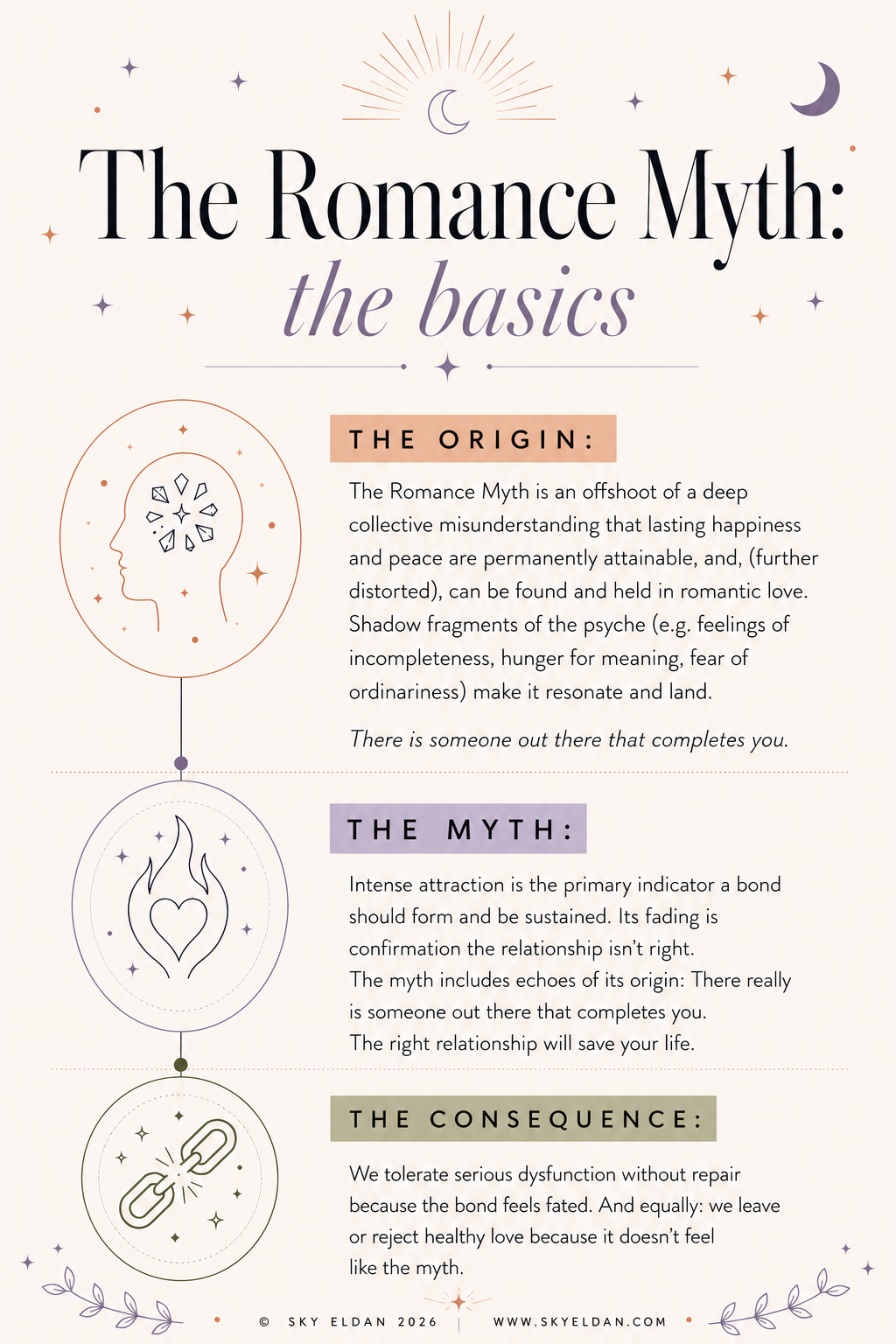
The Romance Myth tells us that intense attraction is the primary indicator that a bond/relationship/attachment should form and be sustained. It justifies the strength of the attraction as evidence that a relationship should continue, regardless of whether or not it is healthy.
Within the myth, romance is distorted from being something pure, natural, ebbing and flowing, into something that must be intense in order to qualify as itself. That is to say: it merges romance with intensity, and if it’s not dramatic and overwhelming, it’s not romance. (Romance is defined later/below.)
Origins of The Romance Myth
The myth originates within a larger collective myth that says happiness can last forever, and that we can ultimately find it in romantic love. It lives in story, fantasy, longing, symbolism, and the cultural atmosphere we inherit around love and romance. We breathe it in before we have the language to question it.
It’s exacerbated by media, which relies on our shadow aspects to create compelling stories. Few people want to watch a movie about grounded, stable love with little drama. People want to be captured, riveted, overwhelmed.
From our earliest years, we consume stories that glamorize obsession, destiny, suffering, emotional volatility, and love without repair. Rom-coms romanticize dysfunction; songs equate jealousy with devotion; algorithms keep us swiping in search of an electric feeling. Again and again, intensity becomes associated with love itself.
The myth is cultural in origin and personal in its points of attachment. Culture transmits the myth; personal history determines how deeply it lands.
Those of us with intense childhoods often become especially susceptible to relationships that recreate familiar emotional conditions. The myth does not create these wounds, but it gives them symbolic meaning and romantic justification.
The Basics
The Romance Myth can manifest differently from person to person, but at its core it confuses intensity with love, certainty, and relational truth.
Look here:
What’s the difference between myth and fantasy?
Myth creates the conditions under which particular fantasies become compelling. Fantasy personalizes the myth through projection, longing, imagination, and attachment.
Consequences of The Romance Myth:
The myth trains us to distrust what is actually good for us. Worse, it trains us to experience healthy love as emotionally underwhelming. When we finally encounter someone kind, emotionally available, grounded, honest, and capable of repair, initially there is often less obsession. That’s because there is less fantasy, agony, uncertainty, and manic projection.
And because there is less intensity, people assume something is missing.
Within the myth, intensity functions as certainty. The louder the feeling, the more real the relationship seems. Obsession feels convincing in a way groundedness often does not. Healthy love, by comparison, can initially feel emotionally quiet—not because it lacks depth, but because the nervous system is not being whipped into conviction.
When living within the myth, people may believe they are available for love, but actually they are organized around intense experience. They reject grounded or emotionally healthy relationships because the steadiness feels emotionally insufficient.
So describe a typical relationship that is the product of the Myth…
In a myth-based relationship, you are primarily in relationship with a projection, a fantasy, or a feeling state that the other person generates in you. They are the drug delivery system. The intensity is both the point and the evidence.
The relationship feels special, fated, extraordinary—something beyond ordinary love. The stronger the feeling, the more convinced the people become that the bond must be real.
Because intensity is treated as the primary signal that the relationship is right, actual relational foundations often become secondary. Compatibility, emotional safety, repair, groundedness, empathy—these things matter less than maintaining access to the feeling itself.
The relationship offers the possibility of an extraordinary life and future.
In such relationships, there is little room for the ordinary seasons, cycles, and chapters that healthy relationships naturally go through, because this would require tolerating periods where the relationship might feel less exciting, sexy, or emotionally consuming. The natural rhythms of life—and the ordinariness that accompanies them—become threatening.
Therefore, when these shifts inevitably appear, even temporarily, they are often interpreted as signs that something is wrong with the relationship itself.
On the other hand, some expressions of the myth do endure seasons—but specifically ones that are highly dramatic, painful, unstable, or emotionally intense. This endurance is not the healthy endurance we see in Steady Love.
What does it feel like within the Myth?
Within the myth, it doesn’t feel like delusion: it feels like finally. Often we feel deep recognition and like the universe is confirming something extraordinary about ourselves and/or the relationship/encounter. Suffering and struggle do not register as a warning sign; instead, they are evidence of depth. Putting up with patterns and behavior without repair begins to feel like devotion rather than self-abandonment or self-betrayal.
Where does the Myth show up the most?
The influence of the myth is often most apparent in why we get together and why we stay together or leave. However, because the myth is a part of the mosaic of our inner worlds, it can be relevant anytime.
Why the Myth feels so beautiful
The myth would not have such power over humanity if it did not touch something real within us. We humans ache for union. We ache to transcend loneliness, separateness, uncertainty, and the ordinary ache of being alive. We long to be seen, chosen, met, dissolved into, transformed by love. Romance and eros genuinely can open us beyond ourselves and flood life with meaning, beauty, vitality, and enchantment.
The issue is not that these longings are fake. The problem is that the myth organizes them around intensity, fantasy, and emotional extremity rather than reality, compatibility, safety, mutuality, and truth. The myth mistakes activation for transcendence.
Part of what makes the myth so convincing is that romance itself is real. Enchantment is real. Attraction is real. Longing is real. Love absolutely can transform a life! Which is precisely why the distortions become so difficult to recognize. The myth feeds on genuine human hunger.
What is true romance?
Romance, in and of itself, is a current of enchantment and connection that is amorphous. Its ebbing and flowing and changing of shapes, textures, tempo, and landscapes is precisely what makes it enchanting in the first place. It is neither static nor perpetually overwhelming. It is loyal to life itself—not to any description of it.
Within romance, achingly beautiful discoveries become possible. It is here that willingness, feeling, sight, and possibility meet the unknown and touch the mystery. This meeting, in and of itself, sparks something alive. Romance relates to our ability to sense subtle beauty, wonder, meaning, and possibility across the whole range of life.
Romance is a first zone, and then an aperture. It originates within us, dependent on nothing except our aliveness. If we are alive, then we contain eros—the animating force of longing, intimacy, vitality, and relational aliveness. When we are in contact with this place of inner romance, we are more likely to notice it in the worlds we inhabit.
Like the world of nature. The world of relationships. The world of friendship. The world of the mundane. The world of cooking, and walking, and reading a book and savoring its smell.
And that is deeply satisfying. There’s a union in that.
It could be the stolen touch of your beloved’s hand on a chaotic Monday morning. Tender, albeit brief, eye contact between diaper changes. It’s there in the sound of your partner’s laughter, their voice carrying the essence of who they are—and in your ability to truly take that laughter in, and be quietly enchanted by it. It’s you letting that be enough, which only further attunes you to notice and experience more of the abounding possibilities of romance that life is full of.
The Myth Isn’t Entirely False
Like many myths, The Romance Myth survives because parts of it contain truth. Attraction matters. Chemistry matters. Longing matters. Transformation through love is all but guaranteed. We are relational creatures, and intimacy can radically alter the course of a life.
The problem is that the myth exaggerates, distorts, and misinterprets certain aspects of love until they become disconnected from reality. Intensity becomes treated as truth. Suffering becomes proof of depth. Fantasy becomes confused with compatibility. Emotional activation becomes mistaken for destiny.
The myth takes real human experiences and organizes them into a distorted emotional logic that often steers people away from the very thing they are actually longing for.
What the Myth Costs
The myth costs people years. Sometimes decades. If it has cost you that, please do not despair: for many of us, it’s part of the curriculum and there is life after graduation.
It keeps us bonded to relationships that repeatedly wound us. It causes us to abandon and betray ourselves, and to reject grounded love because it initially it might feel too ordinary to register as romance.
It can trap us in cycles of longing, uncertainty, projection, obsession, heartbreak, waiting, and fantasy while convincing us that we are pursuing/waiting for something real.
And perhaps most unfortunately, the myth can make us unable to recognize genuine love when it finally arrives. Not because love isn’t there, but because it does not resemble the emotional atmosphere they were taught to associate with romance.
What Relationships Look Like That Are NOT Products of the Myth
The Alternative—Genuine Relationship:
Two imperfect people in relationship who generally see each other as they are and therefore, they are actually in relationship with each other, even if imperfectly. They are still finding out whether or not they will progress into a Steady Love relationship.
Steady Love: What Genuine Relationship Can Become
Two imperfect humans who love each other as they are, who do not expect or need the other to complete some aspect of themselves or their life. They are interdependent, not codependent. They are whole on their own and not waiting for the other to fulfill a fantasy they’ve been holding out for. They take care of each other’s nervous systems and the nervous system of the relationship. Repair, respect, safety, and empathy are their north star. (More to be explained in an upcoming post about Steady Love.) Without even meaning to, this love creates its own myth rather than being the product of myth.
How can you tell the difference between a genuine relationship and one that is the product of myth?
In a genuine relationship, (whether low attraction or high attraction), you are in relationship with an actual person. You see them clearly, (including their limits, flaws, and the sides you are less attracted to), and you’re still interested, still choosing, still curious about who they actually are. The difference isn’t about excitement levels. It’s whether the other person is real to you.
The tell: in myth-based relationships, disillusionment feels like betrayal or loss of love. In genuine relationships, seeing someone more clearly usually deepens the connection.
Note: A genuine relationship can be taken over by the myth if one or both partners begin relating to each other from within it rather than from presence. These are not fixed categories but living ones.
What’s “Steady Love?”
Steady Love is what we’re really looking for via the myth, but the myth directs us away from. Grounded, safe, available; a safe nervous system. Ordinary, safe love which is in and of itself achingly kind. Which is the portal itself. The ache that provides the opening of romance which we yearn for is located within the safety of the relationship’s container—a container in which profound discovery is possible because we are safe enough to go there.
In Steady Love, issues are either worked through successfully or recognized as a relational thread that both partners tend to with awareness, compassion, responsibility, and care.
What does Steady Love feel like?
Steady Love doesn’t arrive with fanfare. At first, it can feel almost suspiciously quiet. That’s not to suggest it isn’t exciting: it certainly can be! The difference is that the excitement is not fundamental to the relationship. In other words, you’re not there because of the excitement.
There is no obsessive thinking because there is nothing to decode. You might still be neurotic. Your stuff can still come up. But this time, it is stuff you can really work on relationally, rather than stuff that—although it might relate to trauma/the past/wounds—it’s also a reasonable reaction to the lack of safety often present in relationships that are the product of the myth.
In Steady Love, there is usually less anxiety because there is nothing being withheld. What’s there instead is a kind of ease that can initially read as flatness, until you realize the flatness is actually ground—solid earth beneath your feet after years of standing on a moving surface.
It deepens slowly. Or, if it deepens quickly, it’s not the being-shot-out-of-your-body speed common to the myth. You absolutely can have a “when you know, you know” type of Steady Love relationship: an immediate sense of rightness from the beginning, and two lives might join together relatively quickly. The difference is, even if things happen fast, your nervous system, boundaries, and limits are respected; and the whole thing is generally grounded.
To be clear: none of this is to suggest that if you’re in a Steady Love relationship, you’ll always feel safe and calm and your nervous system will always be relaxed. Not so! You will continue to be you, imperfect and whole, with all of your mishegoss. And your partner will continue to be them, also imperfect and capable of reacting and making mistakes!
The difference is that in this relationship, mistakes are safe to make. This relationship is a safe place for things to arise, be integrated and possibly even resolved—sometimes soon, and sometimes over the course of the entire relationship.
The difference is also that in these relationships, mistakes are not acts of cruelty.
While this love is both tincture and the place where the remedy can work, it should not be misunderstood as the solution to our problems… for that, as you know, would be myth!
Over time, the relationship may become the most interesting thing in your life— not because it performs, but because it’s real. Reality, when you’re finally safe enough to inhabit it, turns out to be endlessly rich.
Sample content within the Myth:
Hyper-soulmate ideology; twin-flame(!!!) ideology; effortless love; love conquers all; suffering as proof of love; grand gesture culture; The One; destiny and fate narratives; Disney and fairy tale structure; romantic comedy conventions; pop music as myth transmission
Struggle as evidence of depth; the belief that real love requires no maintenance; spiritual exceptionalism (”our connection is beyond what others understand”)
The proposal as proof of worth; romantic love as the supreme life achievement; the wedding as romantic pinnacle; the idea that singleness is failure or waiting
There is someone out there who completes you; the right relationship will save your life.
Possible manifestations/expressions of the Myth:
The myth can manifest through limerence, projection, fantasy bonding, anxious attachment, trauma bonding, obsessive thinking, idealization, merger fantasies, codependency, or nervous-system dysregulation mistaken for chemistry. It often interprets emotional volatility as aliveness.
Within the myth, uncertainty can feel more romantic than stability. Hyper-vigilance becomes mistaken for attunement; jealousy for devotion; emotional suffering for depth. Obsessive thinking is interpreted as proof of connection rather than evidence of psychological fixation.
The myth can also appear in spiritualized forms: the belief that one cannot let go because the connection is cosmically significant, destined, or uniquely transcendent. In these cases, fantasy becomes reinforced not only psychologically, but symbolically and spiritually as well.
At its extreme, the myth mistakes potential for actuality, explaining away incompatibility, lack of repair, or profound relational instability because the emotional intensity itself has become the measure of truth.
How? Why? But
MYTHS FUNCTION SUBTLY! Which is why they are so important to point out and discuss.
Some aspects of indoctrination are subtle. Because the myth enters through imagery and repetition and longing rather than direct instruction, most people do not even realize they are living within a myth, and that they have become organized around these ideas.
It’s also inherited by those who came before us, and affirmed in our familial and social groups, which can make it harder to notice as myth.
Myth operates subtly. It is a constant psychic broadcast from the collective’s town square. We breathe it in and are altered by it before we even realize it’s happening. It impacts, creates, and informs our perspectives. It feels personal, but it’s not.
I understand all of this, so how/why does the Myth persist?
The myth persists not just because of cultural programming but because it is often recreating a familiar emotional blueprint from childhood. That means that those of us who had intense childhoods are geared to look for relationships that will create that familiar feeling of intensity. This is not part of the myth’s origin, but it is a common reason the myth lands so deeply in many people.
Why you can’t think your way out: Understanding the myth intellectually does not automatically free you from it, because it was never installed intellectually. It was installed through feeling, repetition, imagery, and nervous system patterning, usually long before you had the language to question any of it.
You can know everything in this essay and still feel the pull. That’s not weakness. That’s how deep the roots go. Freedom comes not from understanding alone, but from building a new felt sense of what love actually feels like in the body. And that takes time, healing, and a different kind of repetition.
Key Concepts and Phrases
Nervous system activation is not destiny.
There is a difference between healthy passion and passion that is the consequence of uncertainty.
Intensity proves nothing. Cocaine is intense. So is panic and emotional deprivation.
Myth-based relationships are terrified of ordinariness. Romance makes a playground of the mundane.
Romance can survive reality. The myth cannot.
There are relationships that are products of the myth, and then there is Steady Love—a kind of love that creates its own myth without even meaning to.
Transformation and compatibility are not the same thing. Steady Love is transforming, though in a quieter way than myth-based relationships. Steady Love, however, includes compatibility, which is not a requirement/priority in myth-based relationships.
What we lack language for, we lack understanding of. Looking at all of this through the framework of myth can help us to move beyond it.
Exposing The Romance Myth offers a reclamation of romance and love: Moving them out of their distortions and restoring them to their original, pure form. For our health and the health of the world.